Cat Beats - Tiles Music Games
- 4.5
- Rating
- 5.00M
- Installs
- Free
- Price

 Analysis by App-foxy
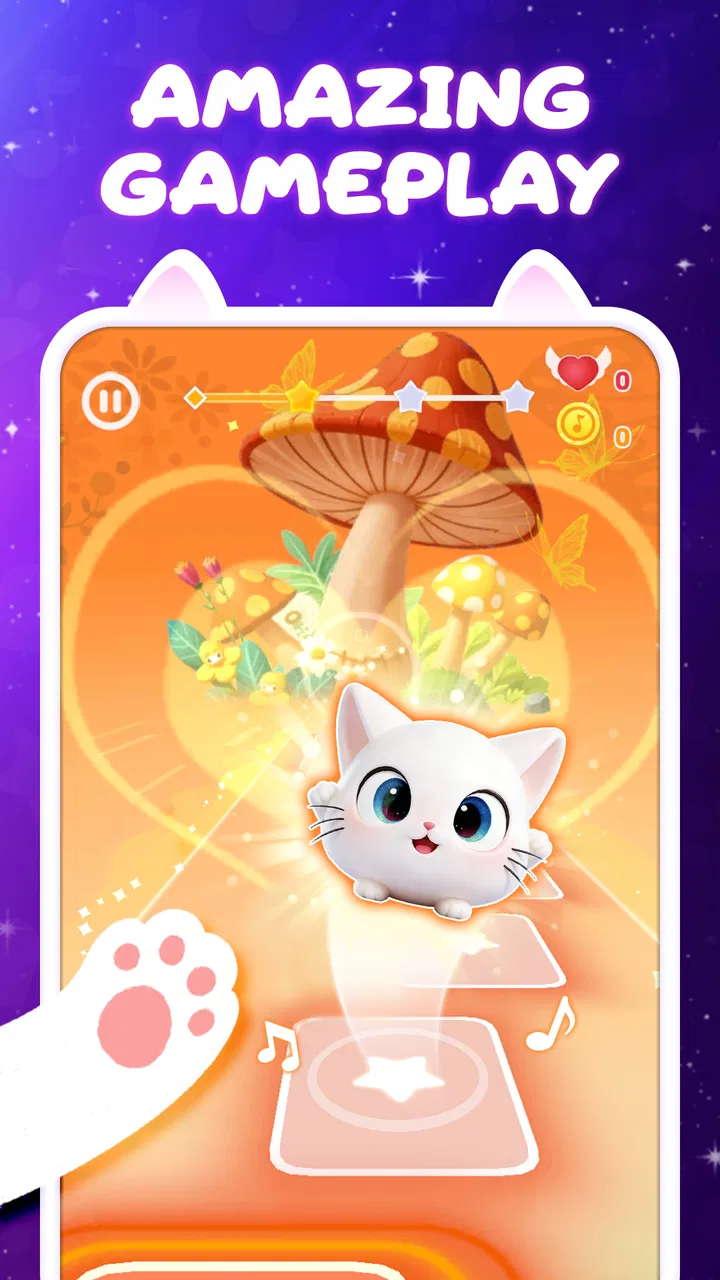
I found Cat Beats - Tiles Music Games easy to understand within seconds: listen for the rhythm, watch the moving tiles, and tap in time. That simple idea gives it an inviting feel, especially when I want a short music game rather than a long session with complicated rules. It is a free Android game from Runyou, placed in the music category, with a cute cat-focused presentation and a strong connection to K-pop songs.
What makes it worth discussing is not just the cheerful theme. A rhythm game lives or dies by how quickly it responds, how clearly it communicates timing, and how well it handles the small frustrations that happen when a player misses a beat. In my experience, this is best approached as a lightweight pick-up-and-play option: something for a quick break, a little practice, or a relaxed attempt to improve your timing.
How Cat Beats feels during ordinary play
The first thing I noticed is how little preparation the concept demands. There is no need to learn a large set of controls before starting. The central action is tapping tiles in time with the music, so the challenge comes from attention and rhythm rather than from memorizing a complicated interface. That makes the game approachable for younger players and for anyone who does not normally spend time with music games.
You May Also Like

 Blood Strike: 2.5 Anniversary
Blood Strike’s Loadouts Turn Every Drop Into a Tactical Gamble
A close look at Blood Strike’s custom loadouts: how fast access to signature weapons reshapes its battle royale rhythm, rewards preparation, and narrows the gap between fights.

 Pandora - Music & Podcasts
Pandora’s Music Is Easy to Start, but Harder to Recover
Pandora’s strength is its low-effort path from a seed to a station. Its weak spot is how much confidence it asks you to place in connection, setup, and quiet recovery.

 8 Ball Pool
 Is Built on Rivalries, Rematches, and Routine
A close look at the rivalries, rematches, shared routines, and unanswered safety questions that turn a quick pool match into a persistent mobile community.

 Samsung Music
’s Quiet Strength Is Playing What You Already Own
Its reach comes less from spectacle than from dependable access to a personal library. That simplicity is both the app’s strongest retention engine and its ceiling.

 AccuWeather: Weather Radar
AccuWeather Review: A Quick, Clear Forecast for Everyday Decisions
For everyday plans, the best forecast is the one you can understand quickly. AccuWeather makes rain timing, radar, and local conditions easy to act on, with a few trade-offs.

 Hill Climb Racing
Why Hill Climb Racing Still Turns Crashes Into One More Run
A tiny car, a bumpy hill and one more upgrade: Hill Climb Racing keeps resurfacing because its simple chaos makes every near-miss feel personal.
More From Our News Desk



The cat styling also changes the mood. Instead of presenting itself as a serious score-chasing simulator, it feels playful and accessible. That matters in everyday use: I can imagine opening it while waiting for an appointment, during a short commute, or when I have only enough time for a few attempts. The format suits those gaps better than a game that expects a long uninterrupted session.
Its audience is broad. The Everyone age rating makes it suitable as a family-friendly choice, while the K-pop focus gives it a clearer identity than a completely generic tapping game. Players who already enjoy that music style may find the songs more motivating than standard background tracks. Players who prefer rock, classical music, electronic mixes, or a broad library may feel less connected to the selection.
What to expect from speed and responsiveness
For a tile rhythm game, perceived speed is more important than visual decoration. I pay attention to whether the next action is readable, whether the beat feels easy to follow, and whether a missed tap seems to come from my timing rather than from confusing presentation. Cat Beats is built around a direct loop, so the game can feel immediately active without requiring a long tutorial or a complicated setup.
That simplicity is also a useful performance advantage in principle. A game centered on tapping tiles does not present the same kind of visual workload as a large three-dimensional title. I would therefore choose it before a graphically demanding game when I want something that feels less intimidating on a basic phone. Still, the exact experience can vary with the device, the operating system, and whatever else is running in the background.
A practical tip is to begin with short sessions and concentrate on the pattern rather than trying to chase a perfect result immediately. Rhythm games often feel faster when I stare at the score or react emotionally to a mistake. Keeping my attention on the incoming tiles makes the pace easier to judge. If the music feels too quick, I would also try playing in a quieter place, because outside noise can make a simple beat seem less consistent.
When repeated play becomes demanding
The most demanding moments are likely to come from sustained concentration rather than from complicated graphics. A player may start comfortably, then lose accuracy after several attempts because the eyes, hands, and ears are no longer working together as cleanly. That is a normal trade-off for this kind of game: the controls are simple, but maintaining precise timing is not always easy.
Heavy use can also mean repeated restarts. A short failed attempt may encourage me to try again immediately, especially if I feel that the mistake was close to the correct beat. This creates a useful “one more try” loop, but it can also become tiring. I would recommend treating each attempt as practice instead of measuring the whole experience by the highest score. That approach makes the game less frustrating and helps reveal which sections of a song cause trouble.
For a child, the straightforward tapping may be entertaining without being overwhelming, but supervision can still be sensible during long play sessions. The Everyone rating describes the intended age suitability; it does not mean every player will have the same tolerance for rapid visual movement or repeated attempts. Short breaks are a better habit than continuing after attention has clearly dropped.
One less obvious use is as a gentle coordination exercise. I would not treat it as a formal training tool, but the connection between hearing a beat and responding with a tap gives the game more value than passive music listening. It can also work as a warm-up before a more demanding rhythm title. After a few rounds, I have a clearer sense of whether I am in the mood for precision play or simply want to listen to music.
Stability, recovery, and the small moments that matter
Reliability in a rhythm game is about more than whether it opens. A brief interruption matters because timing is continuous: if the game pauses unexpectedly, the player can lose the beat and the whole attempt may feel spoiled. That is why I judge a title like this by how comfortable it is to return to after switching away, receiving a notification, or making a mistake.
Cat Beats benefits from a compact core idea. There are fewer layers to understand than in a large music platform, and that should make recovery from a failed attempt feel straightforward. If I miss a tile, I want to be able to understand what went wrong, reset my focus, and continue without turning the mistake into a long interruption. The game’s appeal depends heavily on that quick restart rhythm.
Even so, players should keep realistic expectations about mobile games. A phone may be busy with other apps, low on available resources, or dealing with an unstable environment. Those conditions can affect any timing-based experience. Before blaming my taps, I would close demanding background apps, make sure the device is not struggling with heat, and play somewhere with a stable audio experience. Those steps are especially useful when the music seems out of sync with the visual action.
The current version is 1.0.13, which gives the game a specific point of reference for anyone deciding whether to install it now. I would still keep the app updated through the normal store process, since rhythm games can benefit from fixes that improve compatibility or smooth out small problems. I would not assume that an update automatically changes the song selection or adds a particular feature unless the developer explains it directly.
Device limits and everyday resource demands
The minimum operating-system requirement is Android 7.0, so the game is aimed at a wide range of Android phones rather than only recent models. That is helpful for people using older hardware, but the operating-system requirement should not be confused with a guarantee of identical performance on every compatible device. Age, available storage, background activity, screen quality, and audio behavior can all influence how comfortable a timing game feels.
On a newer phone, I would expect the basic tile interaction to feel more at home than a visually intensive game would. On an older handset, the main concern is not necessarily graphics quality; it is whether taps and sound remain consistent during play. If the phone feels sluggish elsewhere, Cat Beats may not be the best place to demand perfect timing, even though the game itself is designed around a simple interaction.
There is also a resource trade-off between convenience and concentration. Playing with several other apps open may be convenient, but it can make the phone work harder and introduce distractions. For the cleanest experience, I would start the game after closing anything unnecessary, lower unrelated interruptions, and use headphones only if they feel comfortable and do not introduce noticeable delay. A quiet speaker setup may be better than headphones if the headphones make the beat feel late.
Another practical question is whether this is a good choice for a very old device. The Android requirement allows older systems, but the best answer depends on the phone’s overall condition. I would try it on such a device with modest expectations and test a few songs before relying on it for longer sessions. If the screen response already feels inconsistent in other apps, a rhythm game will expose that weakness quickly.
How it compares with ordinary alternatives
Compared with a general music streaming app, Cat Beats is interactive rather than passive. It asks me to participate, so it is better when I want a small challenge or a way to stay engaged with a song. A streaming app is the better choice when I want uninterrupted listening, a large range of artists, or control over a personal playlist. Cat Beats should not be judged as a replacement for those services because its purpose is different.
Compared with a more complex rhythm game, this one is easier to approach. A demanding competitor may offer deeper progression, more elaborate presentation, or a broader set of mechanics, but it can also require more time to learn. Cat Beats makes more sense for a casual player who wants the basic pleasure of tapping to music without committing to a large system. Experienced rhythm-game fans may eventually want more depth if they are searching for detailed customization or a serious competitive routine.
The K-pop angle is another deciding factor. If that style is already part of my listening habits, the music theme gives the taps a stronger reason to matter. If I am indifferent to K-pop, the cute art may still be enough for short sessions, but the game’s identity will feel less distinctive. In that situation, a rhythm game built around my preferred genre would probably be a better long-term match.
It is also different from a standard casual puzzle game. The challenge is not simply choosing the correct tile or planning several moves ahead. Timing is the central skill, which means the game can feel rewarding when I improve but unforgiving when my attention slips. Someone looking for a calm, pause-anywhere puzzle may prefer a turn-based alternative, while someone who enjoys music-driven reactions will probably appreciate the immediacy here.
Who should install it, and who should pass
I would recommend Cat Beats to someone who wants a free music game that can be understood quickly, enjoys cute presentation, and likes the idea of K-pop songs shaping the play session. It is especially suitable for short breaks, family-friendly entertainment, and players who are new to tile-based rhythm games. The large existing audience also suggests that the concept has broad appeal: it has passed one million installs and holds a 4.8 average from around 3.1 thousand ratings.
Those figures are encouraging, but they do not remove the need to match the game to personal taste. A high average rating cannot tell me whether I will enjoy the particular songs, the speed of the taps, or the amount of repetition. I would use the game for its focused rhythm loop, not because popularity guarantees that every session will be satisfying.
I would skip it if I want a deep music library, a full listening service, or a game with extensive strategic systems. I would also look elsewhere if my phone has unreliable touch response or if I dislike replaying short sections to improve timing. The title’s simplicity is a strength for casual players, but it can become a limitation for anyone wanting a large-scale rhythm experience.
For a realistic everyday scenario, imagine having ten minutes before leaving home. I can open the game, play a few attempts, and stop without needing to remember a complicated campaign. If I miss repeatedly, I can put it down rather than losing significant progress. That makes it more practical than a long-form game when my schedule is fragmented, although it may be less satisfying when I have an entire evening available and want a richer experience.
My performance verdict
My overall view is that Cat Beats works best as a focused, approachable rhythm game rather than as an all-purpose music app. Its simple tapping format should keep the basic experience accessible, and the cat theme gives it a friendly personality. The Android 7.0 minimum also makes it a reasonable candidate for people who are not using the newest phone, provided the device still handles touch input and audio consistently.
The main performance lesson is to protect the timing experience. Keep distractions low, avoid judging the game during a phone slowdown, and give your ears and eyes a break when repeated attempts stop feeling accurate. Those habits do more for enjoyment than trying to force a long session. The game is at its best when I treat it as a quick rhythm exercise with music I enjoy, not as a test that must be conquered every time.
Runyou has chosen a clear direction: cute tiles, quick reactions, and K-pop energy in a free package. I like that it does not demand a large commitment before becoming playable. I would recommend it to casual Android players who want something lively for short sessions, while experienced rhythm fans should decide whether the straightforward design offers enough depth for them.
My final recommendation is simple: install it if you want an easy-to-start music game and enjoy the specific style it brings. Skip it if your priority is uninterrupted listening, a huge song catalog, or advanced rhythm mechanics. For the right player, Cat Beats is a pleasant little timing game that makes spare minutes more interactive without asking the phone to behave like a high-end gaming machine.
It is free to play and rated Everyone, so the barrier to trying it is low. After a few rounds, the important question is not whether it is the biggest music game available, but whether tapping along with its songs feels satisfying on your device. In my experience, that is where its real value lies: quick access, a cheerful presentation, and a compact challenge that is easy to return to whenever I want a musical break.
FAQs for Cat Beats - Tiles Music Games
01What is Cat Beats - Tiles Music Games all about?
Cat Beats - Tiles Music Games is a rhythm-based game where players tap on tiles in time with the music. The game features a cute cat theme, offering a variety of songs and difficulty levels to challenge players. It's designed for music lovers who enjoy interactive gameplay and adorable graphics.
02Is Cat Beats - Tiles Music Games free to play?
Yes, Cat Beats - Tiles Music Games is free to download and play. However, it offers in-app purchases for additional content such as exclusive songs and aesthetic customizations. These purchases enhance the gaming experience but are not necessary to enjoy the core features of the game.
03What are the system requirements for Cat Beats - Tiles Music Games?
Cat Beats - Tiles Music Games requires Android 5.0 or iOS 10.0 and above to run smoothly. It's optimized for most smartphones but performs best on devices with at least 2GB of RAM. Ensure your device has sufficient storage space for seamless installation and updates.
04How does the game ensure a variety of music choices?
The game offers a wide selection of music genres, including pop, classical, and electronic. The developers frequently update the song library, ensuring players always have new tracks to discover. Additionally, some special events introduce exclusive songs for limited times.
05Can I play Cat Beats - Tiles Music Games offline?
Cat Beats - Tiles Music Games can be played offline, allowing you to enjoy your favorite tracks without an internet connection. However, online features such as leaderboards and song updates require a connection. Playing online also enables you to participate in special events and challenges.
Pros
- Engaging rhythm gameplay keeps you entertained.
- Wide variety of music tracks to choose from.
- Intuitive controls make it easy to play.
- Cute cat-themed graphics enhance the fun.
- Regular updates add new songs and features.
Cons
- In-app purchases can become costly.
- Occasional ads interrupt gameplay.
- Limited offline play options available.
- Some songs locked behind paywalls.
- Gameplay may feel repetitive over time.

Cat Beats - Tiles Music Games
Gallery